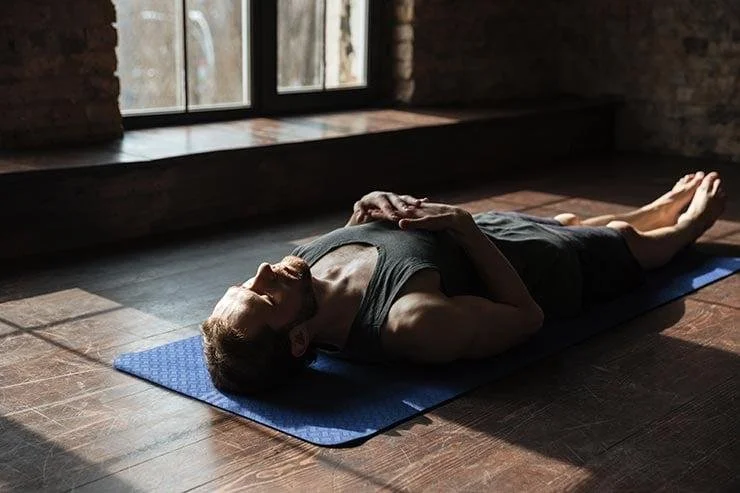
Integrative Breathwork
A deeper way of exploring breath, body and inner experience.
Integrative Breathwork is a personalized conscious connected breathing practice that combines breath, body awareness and relational techniques to explore emotional patterns, support nervous-system awareness and regulation, and deepen self-understanding.

What is Integrative Breathwork?
Integrative Breathwork is a practice of conscious connected breathing — a dynamic and transformative approach that can support deep personal growth, somatic awareness, nervous-system regulation, and emotional processing.
This approach draws on core elements from seven distinct breathing traditions, incorporating well-known methods such as Stanislav Grof’s Holotropic Breathwork, Leonard Orr’s Rebirthing, and ancient Pranayama practices.
The primary advantage of the integrative approach is its adaptability.
Rather than following a rigid, single-modality framework, Integrative Breathwork can be adapted to the individual and their current state. A session may range from gentle, grounding breathing to a deeper, more intense and energetically powerful experience, depending on what is appropriate for the person and the process.
Beyond the breath itself, targeted somatic tools may be incorporated throughout the session to support a safe and responsive process, increase body awareness, and explore patterns of physical tension and emotional activation.
One of my favorite aspects of this work is the direct interaction with the client during the session.
By incorporating elements of Voice Dialogue into the breathwork process, we can explore physical sensations, emotional responses, inner voices, and parts of the self that may be difficult to access through conscious thinking alone.
Rather than imposing an interpretation, we stay curious about what the body and inner experience are communicating. This dialogue can help bring greater awareness to subtle signals, uncover patterns, and create space for meaningful and lasting change.
How Does Connected Breathing Work?
The breath is a bridge between awareness and deeper experience.
Breathing is one of the few processes in the body that happens automatically, while also being something we can consciously influence.
Most of the time, we breathe without thinking about it. Our breathing naturally changes in response to our physical condition, emotions, environment, activity, and level of stress. When we bring conscious awareness to the breath, we can begin to influence its rhythm, depth, and quality.
Connected breathing creates a sustained, conscious relationship with the breath. By maintaining a continuous flow of breathing and allowing the body to relax, the practice can shift our usual patterns of attention and perception and open the door to experiences that may be difficult to access through thinking alone.
For some people, this may bring greater awareness of physical sensations, emotions, memories, imagery, inner voices, or deeply familiar patterns of responding. Others may experience changes in perception, a sense of spaciousness, deep stillness, or an altered state of consciousness.
These experiences do not need to be interpreted or forced. Rather than assuming in advance what they mean, we stay curious about what emerges and explore it together.
From tension to awareness
The way we breathe is closely connected with how we experience ourselves physically and emotionally. Changes in breathing can influence bodily sensations, arousal, attention, and our subjective experience.
By slowing down, relaxing unnecessary muscular effort, and bringing awareness to the body, we may begin to notice patterns of tension, activation, resistance, or holding that usually remain outside our conscious attention.
The intention is not to force a release or to recreate a particular experience.
It is to create enough awareness and space for whatever is present to become more visible.
Sometimes that may involve emotion. Sometimes it may involve a memory or image. Sometimes there may be a physical sensation, a realization, a sense of connection — or simply stillness.
Nothing has to happen.
The principles of a session
At the heart of connected breathwork are three simple principles:
Breath — staying connected with the rhythm of the breath.
Relaxation — allowing unnecessary effort and resistance to soften.
Surrender — allowing the experience to unfold without forcing a particular outcome.
You remain the authority of your own experience.
My role is not to tell you what your experience means, but to help you stay present with it, ask the right questions, and explore what may be asking for your attention.

BREATH
·
RELAXATION
·
SURRENDER
·
BREATH · RELAXATION · SURRENDER ·
Physiological Perspective
What happens in the body?
Breathing has a direct relationship with the body's physiology. When the pattern, depth, and pace of breathing change, so can levels of oxygen and carbon dioxide in the blood, as well as cardiovascular activity and the balance of the autonomic nervous system.
During continuous connected breathing, these physiological changes can influence bodily sensations, arousal, attention, and subjective experience. Depending on the intensity and duration of the practice, some people may experience changes in perception, a deep sense of relaxation, heightened emotional awareness, or an altered state of consciousness.
These experiences can feel very different from ordinary waking awareness.
In such states, people may experience memories, images, emotions, bodily sensations, symbolic material, or insights that are not usually present in everyday consciousness.
Experiencing and observing
One of the distinctive aspects of breathwork is that you can remain both deeply engaged in your experience and aware of what is happening as it unfolds.
At times, this can create a sense of perspective — allowing you to observe familiar emotions, reactions, memories, or patterns from a different point of view.
With guidance and integration, this perspective may help you relate to past experiences with greater awareness, compassion, and choice.
The aim is not to erase the past or force a particular interpretation.
It is to develop a different relationship with what you have experienced — so that what once felt automatic may gradually become something you can observe, understand, and respond to differently.
Holistic Perspective
Breath as a pathway into the whole experience of being human
In many traditional breathing practices, the breath is understood not only as a physiological process, but also as a pathway to life energy, presence, and expanded awareness.
In yogic and other Eastern traditions, this vital energy is often described as Prana. From this perspective, conscious breathing can be experienced as a way of increasing vitality and allowing energy to move more freely through the body.
People may experience this as tingling, warmth, waves of sensation, energetic movement, vibration, spaciousness, or a sense of profound connection.
In Frequency of Breath, this energetic perspective can be explored alongside the physical, emotional, mental, and spiritual dimensions of experience.
Four dimensions of experience
A breathwork session can touch different aspects of your experience at the same time:
Physical — sensations, tension, movement, temperature, vibration, and changes in bodily awareness.
Emotional — grief, anger, joy, fear, tenderness, love, or other emotions that may arise.
Mental — thoughts, beliefs, inner dialogue, perspectives, insights, and shifts in how you understand yourself.
Spiritual / Transpersonal — experiences of connection, unity, meaning, transcendence, symbolic imagery, or states that may feel larger than the individual self.
These dimensions are not separate compartments. One experience can move through several of them at once.
A physical sensation may bring an emotion.
An emotion may reveal a familiar pattern.
A shift in perspective may change how you relate to that emotion.
And sometimes an experience may feel deeply spiritual or transpersonal without needing to be explained.
Every session is different
There is no single experience that a breathwork session is supposed to produce.
You may experience intense physical sensations, emotional movement, deep relaxation, mental clarity, vivid imagery, a sense of energy moving through the body, profound stillness, bliss, connection — or very little at all.
Some experiences may feel meaningful immediately. Others may only make sense later, through reflection and integration.
You don't need to believe in Prana, energy, chakras, or any particular spiritual framework for the work to be meaningful.
These are maps for exploring human experience — not requirements for the experience itself.
Experience comes first. The framework is there to help you explore it.

What Are the Benefits of Integrative Breathwork?
What can this work support?
Integrative Breathwork is not about forcing a particular outcome or fixing something that is “wrong” with you.
It is an opportunity to become more aware of yourself — through the breath, the body, emotions, thoughts, and deeper patterns of experience.
People come to breathwork for many different reasons. Some are looking for greater self-awareness. Others want to reconnect with their body, explore recurring emotional patterns, or create more space between what they experience and how they respond.
Depending on the person and the process, Integrative Breathwork may support:
Greater self-awareness — noticing patterns, reactions, emotions, and bodily signals that may usually remain outside conscious attention.
Deeper connection with the body — developing a more direct relationship with physical sensations, tension, movement, and internal states.
Emotional processing — creating space to experience and explore emotions that may be difficult to access or express in everyday life.
Stress awareness and regulation — becoming more aware of activation, tension, and the ways you respond to stress.
Greater emotional flexibility — developing more choice in how you relate to difficult emotions and familiar reactions.
Exploration of recurring patterns — becoming curious about behaviours, beliefs, relationships, and protective strategies that may no longer serve you.
A different perspective — gaining distance from familiar experiences and seeing yourself, your relationships, or your life from a new point of view.
Inner clarity — allowing insights, realizations, or new questions to emerge through direct experience rather than thinking alone.
Connection and presence — cultivating a deeper sense of being present with yourself, your body, and the people around you.
Meaning and personal growth — exploring questions of identity, purpose, spirituality, and consciousness when these are relevant to your journey.
Some people experience physical release, emotional movement, profound relaxation, vivid imagery, shifts in perception, or altered states of consciousness. Others experience something much quieter.
There is no single experience that means the work is “working.”
And there is no particular outcome you need to achieve.
You don't have to fix yourself.
The intention is not to erase difficult experiences, remove every symptom, or become someone different.
It is to develop a different relationship with what is already here.
With greater awareness, what once felt automatic may become something you can observe.
What once felt overwhelming may become something you can approach with more capacity.
And what once seemed like a fixed part of who you are may become something you can explore with curiosity and choice.
What happens in a session?
01 — Arrival
We talk about what is happening in your life and what you want to explore.
02 — Preparation
We establish the intention, boundaries and the way we will work together.
03 — Connected breathing
I guide you through a personalized breathing process while staying responsive to your nervous system and what emerges.
04 — Exploration
Depending on what arises, we may work with body sensations, emotions, movement, sound or Voice Dialogue.
05 — Integration
We slow down, reflect and make sense of the experience.
This work may be for you if…
You understand your patterns intellectually, but still find yourself repeating them.
You feel disconnected from your body or emotions.
You have tried talking about your experiences, but something still feels unresolved.
You want to explore yourself beyond intellectual understanding.
You are looking for a deeper relationship with your body, emotions and inner experience.

YOU DON'T NEED TO KNOW WHAT YOUR EXPERIENCE MEANS BEFORE YOU BEGIN.
You don't need to believe in any particular framework.
You don't need to force a breakthrough.
You don't even need to know exactly what you're looking for.
We start with what is actually here — the breath, the body, the emotions, the patterns, the questions.
Experience comes first.
The frameworks are maps — not the territory.