ADHD or Digital Overload? How Social Media is Changing Our Attention
The Attention Crisis in the Digital Age: Are We All Developing ADHD, and How to Protect Our Brains? Neuroscience, digital habits, the attention economy, and practical strategies for life in the modern workplace.
We live in an era where human attention has become one of the most valuable resources in the world. Every day, our brains process a massive amount of information: emails, news, notifications, social media content, work tasks, videos, advertisements, and demands from other people.
We simultaneously try to work, reply to messages, listen to colleagues, check our phones, and keep up with what is happening in the world.
However, the human brain did not evolve to operate continuously in this mode.
An increasing number of people admit that they find it difficult to concentrate, read long texts, finish started tasks, listen to long conversations, or simply spend time in silence. Many feel anxious when their phone is not nearby and automatically check it even when they have not received a single notification.
This raises the question: Are we all gradually developing an attention deficit? Can the digital environment create ADHD-like difficulties? And if we cannot simply abandon technology, how can we preserve our concentration, mental health, and ability to work effectively?
In this article, we will examine the nature of attention and ADHD, the impact of the digital environment, the mechanisms of the attention economy, the costs of multitasking, and practical strategies that can help preserve cognitive resources.
PART 1
Diagnosis or Environment? The Neuroscience Behind the Modern Attention Crisis
Do ADHD traits apply to everyone? Is there a theory that ADHD is actually present in all people, just to varying degrees of intensity? This idea is related to the dimensional or continuum approach used in psychology and psychiatry. Many human psychological traits cannot simply be divided into two categories—"present" or "absent." They can be expressed to varying degrees.
For example, anyone may sometimes find it difficult to:
concentrate on a boring task;
finish what was started;
control impulses;
remember what needed to be done;
plan time;
endure monotonous activity;
refrain from immediate gratification;
avoid interrupting a conversational partner;
postpone an important task;
make a decision when there are too many options.
These difficulties in themselves do not mean that a person has ADHD. Attention and executive function capabilities genuinely differ among people, and some ADHD-characteristic traits can also be found in people without this diagnosis. However, it does not follow from this that everyone has ADHD. ADHD, or Attention-Deficit/Hyperactivity Disorder, is a neurodevelopmental disorder with specific diagnostic criteria. The diagnosis is made taking into account the nature, duration, onset, manifestations in various life environments of the symptoms, and their impact on a person's functioning.
ADHD as a Spectrum — What Does It Mean? The dimensional approach helps us understand that attention span, impulse control, and executive functions vary among individuals. However, ADHD is not simply an attention difficulty "spectrum" where everyone occupies some position. Specific ADHD traits may be present in people without a diagnosis, but ADHD is a distinct neurodevelopmental disorder with specific diagnostic criteria.
However, it is important to distinguish between two things:
ADHD-characteristic traits, such as forgetfulness or difficulty concentrating, which anyone may occasionally experience.
An ADHD diagnosis, which is established when the set of symptoms, their developmental history, frequency, and impact on functioning meet diagnostic criteria.
What is ADHD and How Does It Manifest?
Attention-Deficit/Hyperactivity Disorder (ADHD) is a neurodevelopmental disorder characterized by a persistent pattern of attention regulation and/or hyperactivity-impulsivity symptoms. It can affect learning, work, relationships, daily organization, and other areas of life. ADHD is not simply an "inability to concentrate," laziness, lack of discipline, or unwillingness to make an effort. Symptoms may be related to difficulties in regulating attention, initiating and completing actions, sense of time, impulses, and activity levels. At the same time, ADHD manifestations vary from person to person.
Main Symptom Groups of ADHD ADHD symptoms are divided into two groups: inattention and hyperactivity/impulsivity. A person may have more pronounced symptoms of one group or features of both groups.
Inattention This can manifest as:
difficulty paying attention to details or frequent careless mistakes;
difficulty sustaining attention on tasks or activities;
the impression that the person is not listening when spoken to directly;
difficulty following instructions and finishing started tasks;
difficulty organizing tasks, planning, and managing time;
avoidance of tasks that require sustained mental effort;
frequent loss of necessary items;
easy distraction by surrounding stimuli or one's own thoughts;
forgetfulness in daily activities.
Hyperactivity and Impulsivity Hyperactivity can manifest as:
restlessness, a need for movement, fidgeting with hands or feet;
difficulty sitting still in situations where it is expected;
a feeling that the person is constantly "on the go" or driven by a motor;
difficulty quietly engaging in leisure activities;
excessive talking.
Impulsivity can manifest as:
blurting out answers before questions have been completed;
difficulty waiting one's turn;
interrupting conversations or other people's activities;
acting before evaluating consequences.
In adults, hyperactivity does not always look like pronounced physical movement. It can manifest as internal restlessness, difficulty relaxing, constant busyness, or a feeling that one must always be doing something. However, these signs in themselves are not sufficient for an ADHD diagnosis.
How is an ADHD Diagnosis Evaluated?
According to DSM-5-TR diagnostic criteria (American Psychiatric Association, 2022), evaluation considers not only the presence of symptoms but also their duration, developmental history, manifestations across multiple life environments, and impact on functioning.
Main criteria in brief:
symptoms are persistent and last for at least 6 months;
several symptoms must have been present before the age of 12;
symptoms manifest in at least two environments, such as home, school, work, or relationships;
they have a clear, negative impact on social, academic, or occupational functioning;
the symptoms are not better explained by another mental disorder, substance use, or another medical condition.
The symptom count criterion depends on age: children up to 16 years old require at least six symptoms in one or both symptom groups, while individuals aged 17 and older require at least five symptoms in one or both groups. These numbers are not a self-diagnosis test. The diagnosis is determined by a qualified healthcare professional by evaluating the overall clinical picture and developmental history (NIMH, n.d.).
Why is ADHD Sometimes Only Recognized in Adulthood?
ADHD symptoms begin in childhood, but this does not mean the diagnosis is always made in childhood. For some people, difficulties may have gone unnoticed earlier because:
symptoms were less conspicuous, especially inattentive manifestations;
the person developed compensatory strategies;
family or school structures helped cope with daily demands;
people around them explained difficulties away as laziness, daydreaming, personality, or lack of motivation;
later in life, work, relationship, family, or organizational demands increase, and previously used strategies are no longer sufficient.
Therefore, a diagnosis made in adulthood does not mean that ADHD "originated" in adulthood. In diagnostic evaluation, it remains important to ascertain whether symptoms were present in childhood (CDC, n.d.; NIMH, n.d.). This article is not an ADHD self-diagnosis instrument. If difficulties with attention, impulsivity, or organization are persistent and significantly impact life, it is recommended to consult a specialist who performs ADHD diagnostic evaluations.
Why Does It Seem Today Like Almost Everyone Has ADHD? This feeling can be fostered by several factors.
The Modern Environment and the Attention Economy Smartphones, social media, short videos, notifications, and a continuous flow of information create an environment where attention is frequently interrupted. Such an environment can foster attention difficulties, impulsive phone-checking, and a dislike for long, monotonous tasks. However, it is important to emphasize: it has not been proven that the digital environment causes ADHD by itself. It is more precise to speak of digitally related attention difficulties that can resemble certain ADHD traits.
Chronic Stress and Overload Stress, sleep deprivation, and burnout can affect attention, working memory, and the ability to organize activities. A person living in prolonged overload may experience:
"brain fog";
forgetfulness;
difficulty concentrating;
impulsivity;
difficulty starting work;
inability to finish tasks;
a feeling that the mind is constantly occupied. These manifestations can resemble ADHD symptoms, but their cause may be different.
Greater Awareness Today, people know much more about ADHD, neurodiversity, and executive functions. This helps many recognize their difficulties, but at the same time, it can foster self-diagnosis if individual traits are interpreted as a full-fledged diagnosis.
Digitally Related Attention Difficulties — Can They Resemble ADHD? Sometimes terms like "digital ADHD," "acquired attention deficit," or "secondary attention deficit" are used. These terms are not official ADHD diagnoses. They can only be used as descriptive terms to characterize attention difficulties that may be related to digital habits, stress, sleep deprivation, and environmental demands.
A person who lives for a long time in an environment of continuous stimuli, notifications, and rapid information flow may begin to experience:
difficulty concentrating for long periods;
an impulse to check the phone;
a dislike for slow tasks;
difficulty reading long texts;
anxiety in silence;
frequent switching between activities;
difficulty finishing what was started.
Such difficulties can be real and affect quality of life, even if they are not ADHD.
ADHD and Digitally Related Attention Difficulties
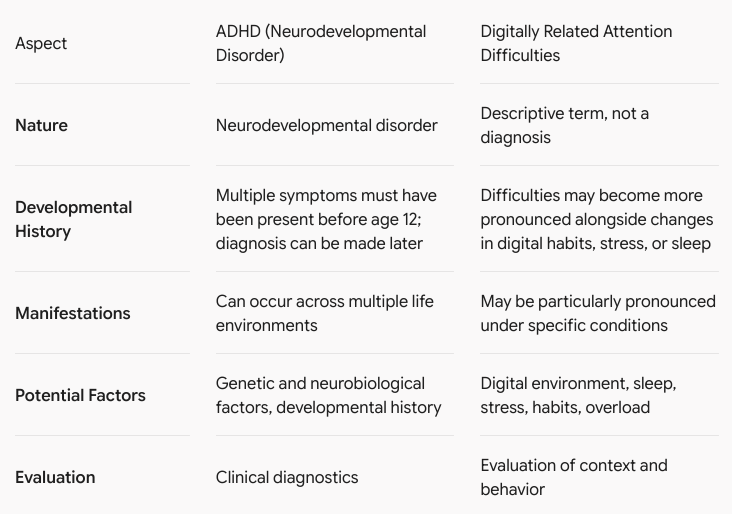
This table is not a diagnostic tool. A person can have ADHD and simultaneously experience overload caused by the digital environment. In fact, these factors can interact with each other. A person with ADHD may find it particularly difficult to resist fast stimuli because they inherently struggle with attention regulation and impulse control. Conversely, a person without ADHD can develop habits from an intensive digital environment that make concentration difficult.
Dopamine — Why Do Our Brains Crave Stimuli?
Dopamine is one of the neurotransmitters involved in motivation, learning, reward prediction, and behavioral choice processes. In popular culture, dopamine is often called the "pleasure hormone," but this characterization is overly simplistic. Dopamine is not just a substance of joy or happiness. It helps the brain learn, understand what is worth seeking, what to pay attention to, and what actions might yield the desired outcome.
Reward Prediction
Let's imagine you check your phone. Maybe there is a new message. Maybe someone commented on your post. Maybe an interesting video appeared. You do not know what you will find. This very unpredictability can make checking appealing. The brain learns from reward and reward prediction. If an action occasionally yields a pleasant or significant result, a person may begin to repeat it. This is one of the mechanisms that can help explain why we check our phones so often.
Unpredictable Reward In behavioral psychology, a well-known concept is variable reward. When a reward is received unpredictably, behavior can sometimes become exceptionally persistent. For example:
on one occasion, there is nothing interesting on social media;
on the next occasion, a funny video appears;
then you receive a message from a friend;
later you see interesting information;
on another occasion, you receive social validation. This unpredictability can foster repeated checking. However, this does not mean every video causes a "dopamine spike" or that dopamine levels continuously rise. The brain's reward system is much more complex.
Can the Brain Adapt to the Digital Environment?
The human brain possesses neuroplasticity—the ability to change, learn, and adapt to experience. We can train various abilities:
reading;
memorizing;
navigating;
planning;
concentrating;
acquiring new habits.
The digital environment can affect our attention habits because we repeatedly train certain behavioral patterns. If every few seconds we switch to a new stimulus, such switching becomes habitual. However, it would be an exaggeration to claim that the brain thereby irreversibly loses the ability to concentrate. Neuroplasticity works in both directions. Attention habits can be influenced by both the digital environment and conscious changes in daily behavior.
What Science Currently Says About Short Videos?
Short video platforms—TikTok, Instagram Reels, and YouTube Shorts—have created a very intensive and fast-changing information environment. Such content often offers:
rapid information exchange;
frequent changes of visual stimuli;
instant access to the next video;
personalized content;
minimal need to actively search for the next piece of information. These qualities can foster prolonged use and make it difficult to stop.
EEG Study on Short Video Use In a study published in 2024, "Mobile phone short video use negatively impacts attention functions: an EEG study," the trend of short video use and attention functions was investigated. The study involved 48 people. Researchers used EEG and an attention task to analyze the relationship between problematic short video use and brain activity. A relationship was found between a more pronounced tendency toward problematic short video use and lower theta wave activity in the prefrontal region during task conditions requiring cognitive control.
However, it is important to understand what this study proves and what it does not prove. It does not prove that:
TikTok causes irreversible brain damage;
short videos cause ADHD;
every short video user experiences reduced attention capacity;
these changes are permanent. It shows a correlation in a specific study sample and under specific task conditions.
Digital Media and Children's Brain Development A 2022 study, "The impact of digital media on children's intelligence while controlling for genetic differences in cognition and socioeconomic background," analyzed 9,855 children. Researchers evaluated digital media usage and intelligence indicators over time. The results were not uniform for all types of digital media:
playing video games was associated with positive changes in intelligence indicators;
social media use showed no such impact;
video-watching results depended on analysis conditions. This study is a good reminder that digital media should not be perceived as a single unified category. Games, social media, educational videos, and short-form content are not identical stimuli.
PART 2 The Attention Economy and Social Media Dopamine Traps
Your Attention is a Business Model
The world's largest technology platforms—Meta and Google—operate in an environment where user attention is a highly valuable resource. This is often called the attention economy. On many platforms, the user does not pay for the service themselves or pays only a fraction of its costs. The platform earns through advertising, data, and user engagement. Therefore, user attention and time become a vital business resource. This does not mean every platform or every employee consciously tries to "break" human self-control. However, platform business models often have an economic incentive to increase:
duration of use;
frequency of user return;
click count;
ad view count;
interaction with content. These goals can conflict with human needs for rest, attention protection, and self-regulation.
TikTok, Reels, and Shorts — The Continuous Stimulation Model Short video platforms use several design elements that can encourage prolonged use.
Unpredictable Reward
You do not know what will be in the next video. One will be boring, the next funny, the third surprising or emotionally powerful. This unpredictability can encourage continuation because the next video is potentially more interesting than the previous one.
Minimal Friction In digital design, "friction" is any action that requires extra effort or a decision. For example:
opening a new page;
entering a search term;
choosing the next video;
confirming an action. On short video platforms, this friction is reduced to a minimum. Videos start automatically. The next one loads immediately. The user does not need to make a conscious decision each time to start new content. This can weaken natural stopping points.
Personalized Content Platforms use various signals to tailor content to the user:
viewing duration;
repeated views;
likes and comments;
content sharing;
search history;
user interaction.
Therefore, the feed can become increasingly aligned with the user's interests. This creates the feeling that the platform "knows" very well what you like. However, the algorithm does not understand humans the way another human does. It processes behavioral signals and forms predictions about what content might hold attention.
Instagram — Social Validation and FOMO
Instagram utilizes not only entertainment mechanisms but also social interaction mechanisms. Humans have a natural need for belonging, relationships, and social evaluation. Therefore, social media can be particularly attractive.
Social Validation Likes, comments, follower counts, and reactions can become external signals that affect self-esteem. A person may begin to regularly check:
whether anyone reacted to their post;
how many people viewed their Story;
whether there are new messages;
whether anyone replied;
whether their content received enough attention. This behavior can become a habit.
FOMO — Fear of Missing Out FOMO (Fear of Missing Out) is the fear of missing an important or interesting event, information, or social experience. Social media can amplify this feeling because information changes continuously. A person might think:
"Maybe someone wrote to me."
"Maybe something important is happening."
"Maybe everyone already knows something I don't."
"If I don't check now, I'll miss out." This state of anticipation can encourage repeated phone checking.
Social Comparison Instagram often shows curated fragments of other people's lives:
travels;
achievements;
relationships;
physical appearance;
financial success;
entertainment. A person compares their daily life with other people's carefully selected best moments. This can create the feeling that others live more interestingly, successfully, or happily. Such comparison is not always harmful, but for some individuals, it can foster dissatisfaction, anxiety, and self-esteem issues.
YouTube — The Infinite Feed and the "Rabbit Hole"
YouTube is an example of a platform where a user may initially search for specific information and then end up in a completely different content stream.
Autoplay
The autoplay function allows the next video to start without an additional user decision. This exploits the default effect: if a person does not need to perform an extra action, they can continue what was started. To stop the feed, a conscious decision is required.
Clickbait Titles and thumbnails often use:
surprise;
fear;
shock;
conflict;
incomplete information;
strong emotions. This can create the so-called curiosity gap. The person wants to know what happens next and clicks.
Infinite Scrolling
A traditional book or newspaper has a natural end point. In the digital feed, such a point often does not exist. If content continues infinitely, the user must create a stopping moment themselves. This can be especially difficult if they are tired or emotionally invested.
Facebook — Emotion, Conflict, and Engagement
On social media, emotionally charged content often receives more attention than neutral content. This can include:
anger;
outrage;
fear;
a sense of threat;
moral condemnation;
conflicts;
emotional stories. A study by Brady and colleagues (2017) showed that moralized emotional content spreads particularly effectively on social media. This does not mean Facebook always preferentially shows negative emotions or that an angry person necessarily spends three times longer on the platform. It is more accurate to say: emotionally charged content can foster engagement and spread.
Nostalgia and Memories
Platforms also use personal memories. Old photographs, past posts, and anniversaries can trigger:
nostalgia;
emotional reaction;
desire to share;
desire to return to the platform. This is not automatically negative. However, it is another way platforms can renew user interest.
Dopamine is Not the Only Mechanism
The formation of digital habits cannot be explained by dopamine alone. It also involves:
habit formation;
social belonging;
emotional regulation;
boredom reduction;
attention switching;
reward prediction;
self-esteem;
sleep and stress. Sometimes a person checks their phone not because they expect pleasant information, but because they want to avoid an unpleasant feeling. For example, they start writing a report but feel confused or uncomfortable. The phone offers a quick way to momentarily escape this feeling. Thus, the phone becomes not only a source of entertainment but also a tool for emotional self-regulation.
Why Do We Check Our Phones Even When There Are No Notifications?
This is a particularly interesting question. A person may check their phone even when no notification light for a new message has flashed and no sound signal has been received. Why?
Habit If a person checks their phone dozens of times a day, this action can become automatic.
Boredom When a small pause occurs, the brain seeks stimulation.
Avoidance of Effort If work is difficult, unclear, or unpleasant, the phone offers an easier alternative.
Expectation A person may unconsciously anticipate a new message, reaction, or piece of information.
Emotion Regulation The phone can become a micro-pause that helps avoid anxiety, frustration, or discomfort. This mechanism is important because it helps understand that the problem is not always "weak willpower." Often, checking the phone is a learned reaction to an internal state.
Future Scenarios: What Might Happen If Attention Fragmentation Continues?
In this matter, scientifically observed trends must be distinguished from possible future predictions. There is no scientific basis to claim that humanity will definitely become "dumber" or that digital technologies will irreversibly destroy the brain. However, researchers and public health experts have expressed concerns about several potential risks.
The Importance of Deep Thinking and Sustained Attention
If a person increasingly rarely engages in activities that require sustained attention, maintaining such habits may become more difficult for them. For example:
reading long texts;
analyzing complex problems;
listening for long periods;
working without interruptions;
tolerating boredom;
thinking without immediate external stimulation.
However, this does not mean these abilities automatically atrophy or disappear. Rather, there is a risk that a person more rarely practices activities where they are required.
Externalization of Memory Today, we often rely on external sources of information:
phone contacts;
calendars;
search engines;
digital notes;
artificial intelligence.
This in itself is not bad. External tools can free up working memory and help organize life. However, there is a difference between storing information externally and understanding it. If a person only finds information but does not process and integrate it, they may learn it less deeply. Therefore, an important question is not only "Do I remember the fact?" but also "Do I understand what this fact means and am I able to use it?"
Social Connection and Loneliness
Digital communication can help maintain relationships, especially over long distances. However, it does not always replace face-to-face contact. Live relationships require:
patience;
empathy;
the ability to listen;
tolerance for discomfort;
conflict resolution;
emotional presence. If a person increasingly chooses controllable digital contact, they may have fewer opportunities to practice these skills. This is not an inevitable outcome, but one of the potential risks.
Cognitive Inequality
One possible future problem is the difference between people who are able to use technology while maintaining independent thinking and people who become completely dependent on digital tools. This is a hypothetical scenario, not a proven future prediction. However, it raises a crucial question: Will the ability to concentrate, think critically, and independently evaluate information become an especially valuable skill in the future? Perhaps yes. Technology can make information more accessible, but it does not automatically make a person smarter.
A Ray of Hope
The human brain is plastic. Attention habits are not unchangeable. The digital environment can influence our behavior, but we can also change our environment, habits, and work organization. The goal is not to give up technology. The goal is to learn to use it without losing the ability to think, feel, concentrate, and be present.
PART 3 How to Maintain Focus, Cognitive Resources, and Survive the Modern Workplace?
How to Know If Attention is Overloaded? There is no single medical test that determines whether the brain needs a "digital detox." However, there are several signs that may indicate the impact of digital habits, stress, sleep deprivation, or overload.
Difficulty Being in Silence
You go to the shower, cook food, or drive a car, and almost automatically turn on:
a video;
a podcast;
music;
radio;
some other background stimulus.
Silence begins to feel unpleasant. This does not mean silence is strictly necessary for everyone, but it may be worth observing whether you can choose silence rather than automatically avoiding it.
Difficulty Reading
You reread the same paragraph multiple times. The mind wanders. The urge arises to check the phone or switch to other content. Such difficulties can be related to attention overload, sleep deprivation, stress, or other factors.
Restlessness During Pauses
Standing in line, waiting for a traffic light or an elevator, your hand automatically reaches for the phone. The pause feels like it needs to be filled.
"Brain Fog"
You feel confused, tired, or incapable of thinking clearly. Simple decisions require more effort than usual. This symptom is not specific to digital overload. It can be related to sleep, stress, health status, or other reasons. If it is prolonged or significantly interferes with daily life, it is worth consulting a healthcare professional.
Automatic Phone Checking
You pick up the phone without really knowing what you are looking for. You open one app, then another, and after a few minutes, you no longer remember why you picked it up. Changing this habit can be helped by increasing the pause between the impulse and the action.
Digital Detox — What Does It Actually Mean?
The term "dopamine detox" is popular, but neuroscientifically it is inaccurate. Dopamine does not need to be flushed from the body, and digital detox does not unprovenly "reset" dopamine receptors. Dopamine is necessary for normal brain function. It would be more accurate to speak of:
reviewing digital habits;
reducing stimuli;
protecting attention;
mindful phone use;
improving the quality of rest and sleep;
the ability to exist without a continuous flow of information. Digital detox does not mean living without a computer for a month. It can be a simple, realistic process where a person breaks automatic digital behavior.
Practical Digital Hygiene Plan
Micro-detox in Daily Life Choose specific time periods during which you do not use social media and entertainment apps. For example:
the first 30–60 minutes after waking up;
meal times;
the last hour before sleep;
walks;
time with family or friends. If work requires using a phone, it does not mean digital hygiene is impossible. It is important to distinguish the use of technology necessary for work needs from checking entertainment content automatically.
Trimming Notifications
Leave only those notifications turned on that are truly important. For example:
calls;
messages from closest people;
critical work notifications. Turn off or limit:
social media notifications;
advertisements;
game notifications;
unnecessary app reminders;
notifications for every new post. If possible, use "Do Not Disturb" or focus mode.
Grayscale Screen
Grayscale mode makes the screen black and white. This can reduce the visual appeal of certain apps and help stop automatic use. This is not a universal solution, but for some people, this small environmental change helps.
Phone Out of Sight
If the phone is on the desk, even without notifications, it can become an object of attention. During work, try:
putting the phone in your bag;
placing it in another room;
leaving the screen face down;
using a separate device for important calls if possible.
Walk Without Headphones
On a weekend or workday, set aside time for a walk without:
a phone;
a podcast;
music;
video;
a continuous flow of information.
Initially, boredom or restlessness may arise. This is not proof that the brain is "damaged." It may simply mean you are accustomed to filling pauses with stimuli. A walk without extra content can be an opportunity to restore contact with the surrounding environment and your own thoughts.
Single-Tasking Training
Choose one activity and perform it without parallel stimulation:
read a book;
cook food;
wash dishes;
listen to a conversation;
go for a walk;
write;
work on a single task.
Start with 10–15 minutes. Gradually, this time can be increased. The goal is not to prove you can concentrate for an hour without interruption. The goal is to restore the habit of staying with one activity without switching at the first sign of discomfort.
Multitasking — How Attention Consumes Our Cognitive Resources?
Multitasking, or performing multiple tasks simultaneously, is one of the main challenges of the modern workplace. Imagine this situation: You are writing an important report. Suddenly an email pops up. You open and read it. Then you reply to a colleague in chat. After that, you return to the report. After a few minutes, the phone rings. You pick it up, reply to a message, and try to continue again. From the outside, it seems like you are working all the time. But in reality, you are constantly switching your attention.
The Brain Cannot Fully Perform Two Complex Tasks Simultaneously The human brain is capable of processing a few simple or automated processes in parallel. For example, an experienced person can walk and talk. However, two tasks that simultaneously require intensive thinking, working memory, and decision-making usually compete for limited cognitive resources. What we call multitasking in daily life is often rapid attention switching (task switching). Task A → switching → Task B → switching → returning to Task A. Each switch can incur additional time and cognitive costs.
Attention Residue Sophie Leroy (2009) described a phenomenon called attention residue. This means that after switching to a new task, a part of attention may remain tied to the previous or just-interrupted activity. For example: You are writing a report. A colleague sends a message: "Can you look at this problem right now?" You open the message, read it, and reply. Then you return to the report. However, in your mind, there may still remain:
the colleague's problem;
the need to do something later;
worry about a deadline;
the thought that you need to reply to someone else;
the context of the previous activity. You have physically returned to the report, but mentally you are not always fully back.
Why is this important? If attention is interrupted multiple times an hour, a person may experience:
difficulty remembering where they left off;
a higher probability of mistakes;
slower thinking;
frustration;
mental fatigue;
the feeling that the day has passed, but nothing has been finished. This does not mean working memory literally "fills up" like a hard drive. Rather, various tasks compete for attention and working memory resources.
Switching Costs
Switching between tasks can incur two types of costs:
Time Costs
Time is required to:
understand the new task;
remember the context of the previous task;
restore the plan;
start thinking about the main problem again.
Cognitive Costs
Switching may require:
attention control;
working memory;
decision-making;
inhibition, or the ability to suppress unnecessary reactions.
This can create subjective fatigue, especially when switching is frequent and tasks are complex.
Does It Take 23 Minutes to Regain Focus After an Interruption?
Frequently, the number 23 minutes and 15 seconds is cited. This figure is linked to Gloria Mark and her research on attention in the workplace. However, it is often misinterpreted. It is not a universal, scientifically proven timeframe required for every individual to regain concentration after each notification. Mark's workplace research examines attention switching, work organization, and the impact of interruptions. People may return to their original task after a few seconds or minutes, but in some cases, they return much later because they engage in other tasks in between. Therefore, it would be more accurate to state: Frequent interruptions can significantly increase the time and mental effort required to return to a complex task.
Does Multitasking Lower IQ?
Popular articles often state that multitasking lowers IQ by 10–15 points. This figure should not be presented as a general, proven decline in IQ. Attention switching can temporarily impair performance on a specific task, but that is not the same as a reduction in an individual's IQ. IQ is a standardized measure of intelligence and cannot simply be interpreted as a fluctuating number that drops every time a person checks an email. It is more precise to speak of:
a temporary reduction in work efficiency;
an increased likelihood of errors;
slower task execution;
working memory strain;
the switching costs of attention.
The Question of Glucose, Oxygen, and "Brain Energy"
The brain consumes a lot of energy and depends on a continuous supply of oxygen and glucose. However, it is inaccurate to claim that every attention switch depletes glucose reserves or that a person experiences localized glucose depletion in the frontal lobe after several notifications. Cognitive fatigue is a complex process that can involve:
prolonged effort;
stress;
sleep deprivation;
motivation;
task complexity;
emotional strain;
the need for attentional control. Therefore, after a fragmented workday, a person may feel exhausted even if they have not performed heavy physical labor. This feeling is real, but its mechanism should not be reduced to simple "glucose depletion."
Decision Fatigue
Throughout the day, we make many decisions:
where to reply;
whom to reply to;
what to do first;
which task to postpone;
what to check;
how to react to a notification;
whether to continue working or switch tasks.
The more actions that require a conscious choice, the greater the subjective mental load can be. The term "decision fatigue" is used to describe situations where prolonged decision-making is associated with fatigue and changes in choice behavior. However, it is not a simple, universal mechanism where a person's decision-making resource is depleted like a battery. The practical conclusion is much simpler: If possible, reduce unnecessary decisions and establish a clear daily structure.
How to Survive in a Workplace That Demands Continuous Responsiveness?
This is one of the most critical questions. We cannot simply quit our jobs, throw away our phones, and live in the forest. Many people work in environments where they must:
reply to emails;
respond to client messages;
prepare reports;
participate in meetings;
use artificial intelligence;
meet deadlines;
switch between different tasks.
Livelihoods depend on work. Therefore, the solution is not to completely abandon technology. The solution is strategic adaptation—using technology to your advantage and protecting your attention where it is most valuable.
Reactive Mode vs. Strategic Mode
• Responds to emails immediately | Responds in scheduled time blocks, if duties allow
• Constantly checks chats | Uses planned communication windows
• Switches task at every notification | Distinguishes urgent from important
• Starts work without a clear plan | Defines the specific next action
• Writes everything from scratch | Uses AI for drafting and structuring
• Tries to do everything at once | Batches similar tasks together
• Rests only when everything is finished | Plans breaks and recovery
This approach will not always be fully possible. Some professions require immediate responsiveness. However, even in such environments, it may be possible to agree on priorities, identify critical notifications, and create a clearer workflow.
Use Artificial Intelligence as Executive Function Support
Artificial intelligence can be particularly helpful in activities that require significant organization, structuring, and initial information processing. For example:
creating a report structure;
summarizing long emails;
drafting an initial document outline;
grouping information;
organizing tables;
structuring ideas;
creating a work plan;
simplifying complex text.
Example Instead of staring at a blank document for hours, you can prompt the AI:"Help me create a report structure. The report must include completed tasks, problems, risks, next steps, and deadlines. Create a professional draft that I can review."
Afterward, you:
verify the information;
add context;
correct errors;
make decisions;
approve the final version.
This allows you to shift part of the workload from staring at a blank page and structuring to editing and evaluating. However, AI should not be viewed as an infallible authority. It can generate:
incorrect facts;
flawed calculations;
nonexistent references;
inaccurate summaries;
inappropriate recommendations. Therefore, human critical thinking and verification remain essential.
AI as Support, Not a Substitute for Thinking
A good principle:Outsource routine structuring to AI, but retain context, evaluation, and responsibility for yourself. If AI decides everything for you, you risk becoming dependent on it. If you use AI to free up time and resources for more complex thinking, it can become a highly valuable tool.
Batching Emails and Messages
If your job duties allow, check emails in designated time blocks. For example:
09:00;
11:30;
14:30;
16:30. This approach helps reduce continuous switching. However, this is not a universal rule. If your work requires a fast response for clients or colleagues, you can adopt a compromise:
critical notifications — immediately;
regular emails — in scheduled time windows;
unimportant messages — later;
social media — outside work focus blocks.
Distinguish the Urgent from the Important Not every notification is urgent. Not every email requires an immediate reply. Not every question from a colleague is a priority. If possible, agree with management on when immediate responsiveness is required and when you can respond later. This helps reduce unnecessary stress.
Scheduled Email Delivery In some email systems, it is possible to use scheduled sending. This can help:
prepare responses in a single block;
send them later;
avoid continuous back-and-forth correspondence;
organize communication. However, this feature should not be used to mislead colleagues about your availability or create a false impression of work. It is better to establish clear communication standards.
Focus Islands — Deep Work
Cal Newport, in his book Deep Work, describes the idea of deep, uninterrupted concentration on cognitively demanding tasks. It is not possible for everyone to work for several hours in continuous deep focus. And it is not necessary. For some people, even one or two well-organized focus blocks a day can be a valuable starting point.
The 45-Minute Focus Block Try the following model:
Choose one important task.
Define a specific outcome you want to achieve.
Turn off unnecessary notifications.
Close extra tabs.
Place your phone out of sight.
Work for 25–45 minutes.
Take a short break afterward.
If 45 minutes is too long, start with 15 or 20 minutes.
How to Explain This to Colleagues? For example:"I will be concentrating on the report for the next 45 minutes and turning off chat notifications. If anything urgent comes up, please call me." Such a notice helps colleagues understand that you haven't disappeared, but are consciously focusing on a specific task.
Workday Structure
This is an example, not a universal ideal schedule.
09:00–09:15 | Daily planning — Set priorities
09:15–10:00 | Focus block — Most important task
10:00–10:15 | Break — Restore attention
10:15–10:45 | Emails & messages — Communication window
10:45–11:30 | Focus block — Continue important work
11:30–12:00 | Communication & operational tasks — Respond to current matters
12:00–13:00 | Lunch and rest — Recovery
13:00–13:45 | AI-assisted tasks — Drafts, summaries, structure
13:45–14:00 | Break — Movement
14:00–14:30 | Emails and communication — Communication window
14:30–15:15 | Focus block — Complete priority task
15:15–15:30 | Break — Recovery
15:30–16:30 | Operational work — Reports, small tasks
16:30–17:00 | Wrap-up of the day — Review accomplishments & plan for tomorrow
If your work is highly reactive, this schedule can be adapted. The most important aspect is not the exact clock times, but ensuring there are at least a few moments in the day where you can think without continuous task switching.
Protect Your Breaks
A break does not need to be filled with more information. If after 45 minutes of work you pick up your phone and watch short videos for 10 minutes, that becomes another period of intense stimulation. During a break, try to:
stand up;
stretch;
go outside;
look into the distance;
drink water;
spend a few minutes in silence;
practice calm breathing. The purpose of a break is recovery, not simply switching to a different type of stimulus.
Stop Competing with Robots
Artificial intelligence and algorithms can process large amounts of information faster than a human. However, human value lies not merely in information processing speed. Humans still possess essential capabilities:
Critical Thinking: The ability to evaluate whether an AI-provided solution is correct, logical, and appropriate for a specific situation.
Contextual Understanding: The ability to comprehend what is happening within a specific organization, relationship, or setting.
Communication and Trust: The ability to converse, listen, resolve conflicts, and build relationships.
Creativity and Synthesis: The ability to connect diverse ideas and create novel solutions.
Responsibility: The ability to make decisions and take responsibility for their consequences.
Artificial intelligence can assist in many of these areas, but humans must still evaluate the results. Smart use of technology is not giving up thinking; it is an opportunity to free up resources to think about what matters most.
Conclusion: How to Maintain Attention and Sanity in the Digital Age?
Modern humans live in an environment where attention is constantly in demand. Social media, work emails, news, notifications, artificial intelligence, and the information stream create a situation where concentration becomes an increasingly valuable resource.
However, it is important not to fall into the opposite extreme:
We must not label every attention difficulty as ADHD.
We must not claim that TikTok irreversibly damages the brain.
We must not view dopamine as a simple "pleasure hormone" that needs to be detoxed.
And we must not blame a person for finding it hard to concentrate in an environment that constantly demands their attention.
Instead, it is worth understanding how our attention works, how digital habits form, and how we can adapt our environment.
Core Principles
Protect attention from unnecessary interruptions.
Reduce the number of notifications.
Batch similar tasks together.
Use AI as support, not a replacement for thinking.
Implement short focus blocks.
Rest without continuous stimulation.
Allow the brain opportunities to experience silence.
Prioritize sleep, physical activity, and relationships.
Do not interpret every attention difficulty as a medical diagnosis.
If difficulties are prolonged and significantly impair daily functioning, seek professional evaluation.
You do not have to be perfect, and you do not have to work like a robot. In today's world, a smart person is not someone who replies to an email in five seconds. A smart person is someone who can leverage technology without losing control over their attention, time, and life.
Shed the unnecessary burden of routine "grunt work" from your brain, use technology to your advantage, guard your attention, and do not let work steal your rest, relationships, and life beyond the screen.
References
Alter, A. (2017). Irresistible: The rise of addictive technology and the business of keeping us hooked. Penguin Press.
Centers for Disease Control and Prevention. (n.d.). ADHD in adults. https://www.cdc.gov/adhd/about/adhd-in-adults.html
National Institute of Mental Health. (n.d.). Attention-deficit/hyperactivity disorder: What you need to know. https://www.nimh.nih.gov/health/publications/attention-deficit-hyperactivity-disorder-what-you-need-to-know
American Psychiatric Association. (2022). Diagnostic and statistical manual of mental disorders (5th ed., text rev.). https://doi.org/10.1176/appi.books.9780890425787
Barkley, R. A. (1997). ADHD and the nature of self-control. Guilford Press.
Brady, W. J., Wills, J. A., Jost, J. T., Tucker, J. A., & Van Bavel, J. J. (2017). Emotion shapes the diffusion of moralized content in social networks. Proceedings of the National Academy of Sciences, 114(28), 7313–7318. https://doi.org/10.1073/pnas.1618923114
Carr, N. (2010). The shallows: What the Internet is doing to our brains. W. W. Norton & Company.
Faraone, S. V., Asherson, P., Banaschewski, T., Biederman, J., Buitelaar, J. K., Ramos-Quiroga, J. A., Rohde, L. A., Sonuga-Barke, E. J. S., Tannock, R., & Franke, B. (2015). Attention-deficit/hyperactivity disorder. Nature Reviews Disease Primers, 1, Article 15020. https://doi.org/10.1038/nrdp.2015.20
Faraone, S. V., Banaschewski, T., Coghill, D., Zheng, Y., Biederman, J., Bellgrove, M. A., Newcorn, J. H., Gignac, M., Al Saud, N. M., Manor, I., Rohde, L. A., Yang, L., Cortese, S., Almagor, D., Stein, M. A., Albatti, T. H., Aljoudi, H. F., Alqahtani, M. M. J., Asherson, P., … Wang, Y. (2021). The World Federation of ADHD International Consensus Statement: 208 evidence-based conclusions about the disorder. Neuroscience and Biobehavioral Reviews, 128, 789–818. https://doi.org/10.1016/j.neubiorev.2021.01.022
Haynes, T. (2018, May 1). Dopamine, smartphones & you: A battle for your time. Science in the News, Harvard Medical School. https://sitn.hms.harvard.edu/flash/2018/dopamine-smartphones-battle-time/
Klingberg, T. (2009). The overflowing brain: Information overload and the limits of working memory. Oxford University Press.
Leroy, S. (2009). Why is it so hard to do my work? The challenge of attention residue when switching between work tasks. Organizational Behavior and Human Decision Processes, 109(2), 168–181. https://doi.org/10.1016/j.obhdp.2009.04.002
Lustig, R. H. (2017). The hacking of the American mind: The science behind the corporate takeover of our bodies and brains. Avery.
Mark, G. (2023). Attention span: Finding focus for a fulfilling life. William Collins.
Newport, C. (2016). Deep work: Rules for focused success in a distracted world. Grand Central Publishing.
Sauce, B., Liebherr, M., Judd, N., & Klingberg, T. (2022). The impact of digital media on children's intelligence while controlling for genetic differences in cognition and socioeconomic background. Scientific Reports, 12, Article 7720. https://doi.org/10.1038/s41598-022-11341-2
Sapolsky, R. M. (2017). Behave: The biology of humans at our best and worst. Penguin Press.
Sun, Y., & Zhang, Y. (2021). A review of theories and models applied in studies of social media addiction and implications for future research. Addictive Behaviors, 114, Article 106699. https://doi.org/10.1016/j.addbeh.2020.106699
Wu, T. (2016). The attention merchants: The epic scramble to get inside our heads. Alfred A. Knopf.
Yan, T., Su, C., Xue, W., Hu, Y., & Zhou, H. (2024). Mobile phone short video use negatively impacts attention functions: An EEG study. Frontiers in Human Neuroscience, 18, Article 1383913. https://doi.org/10.3389/fnhum.2024.1383913